Category | DevOps
Last Updated On 16/04/2026

In an economy where every second of downtime translates into lost revenue and damaged trust, reliability is no longer just an IT concern it’s a business imperative. Research indicates that the average cost of IT downtime can reach up to $5,600 per minute, and for large enterprises, the impact can escalate into millions per hour. As digital experiences become the backbone of customer engagement, organizations can no longer afford disruptions they must engineer resilience at scale.
This is exactly where the SRE director becomes indispensable.
But who is this role really designed for? If you’re a seasoned Site Reliability Engineer aiming to step into leadership, a DevOps professional looking to elevate your career trajectory, or an IT decision-maker seeking to build highly reliable, scalable systems this guide is built for you.
The SRE director is far more than a technical authority. This role sits at the intersection of engineering excellence and business strategy, ensuring that systems are not only functional but consistently reliable under pressure. From shaping reliability frameworks to influencing organizational priorities, the SRE director plays a critical role in modern enterprises. In this blog, we’ll break down everything you need to know from SRE director salary benchmarks to the rising demand for SRE director jobs, and what it truly takes to lead reliability at scale.
An SRE director is a senior technical leader responsible for designing and scaling reliability across complex, distributed systems. Unlike an SRE manager who focuses on execution, the director of SRE operates at a strategic level embedding reliability into architecture, deployment pipelines, and engineering workflows.
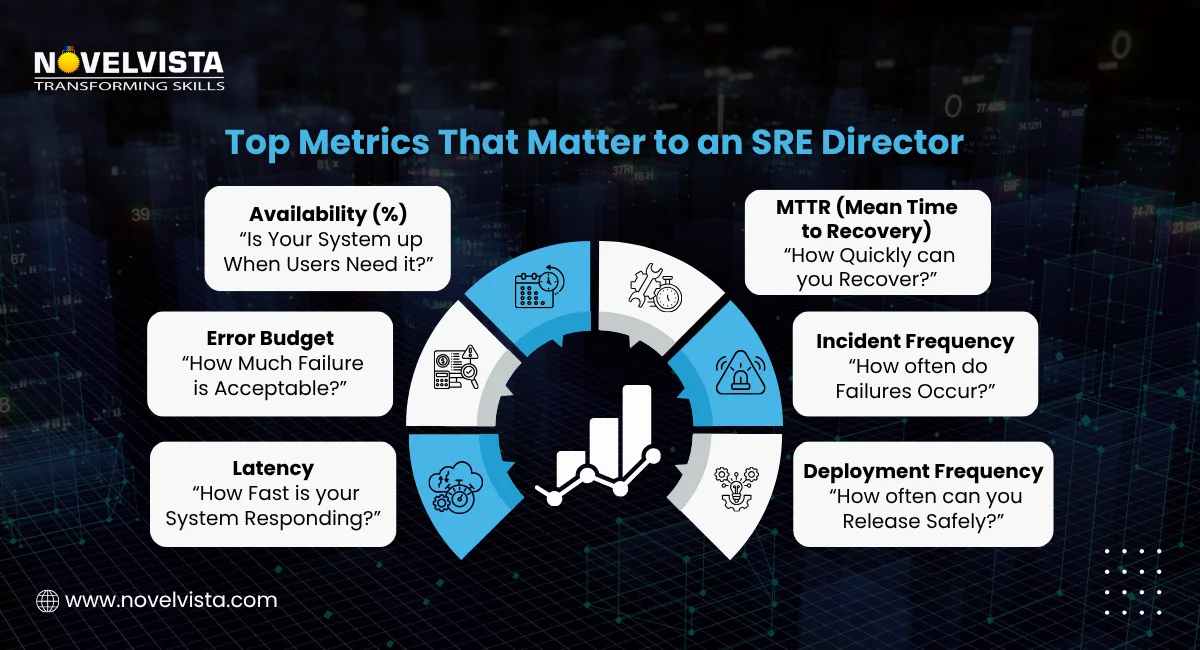
The director SRE defines and governs frameworks like SLOs, SLIs, and error budgets, ensuring the right balance between release speed and system stability. They influence system design decisions such as fault tolerance, multi-region deployments, and observability (metrics, logs, tracing) to enable proactive issue detection.
Rather than handling day-to-day operations, the SRE director focuses on eliminating systemic risks, driving automation, and building scalable, self-healing systems that align reliability with business outcomes.
The responsibilities of an SRE director go far beyond monitoring systems or responding to incidents. This role is about building a culture of reliability.
An SRE director defines service level objectives (SLOs), error budgets, and reliability benchmarks. They ensure that engineering teams follow standardized practices.
During major outages, the director of SRE leads response strategies, ensures root cause analysis, and implements preventive measures.
Automation is at the core of SRE. The director SRE ensures that systems are scalable and resilient through automation tools and frameworks.
The SRE director works closely with DevOps, security, product, and leadership teams to ensure reliability aligns with business goals.
One of the most attractive aspects of becoming an SRE director is the compensation.
The SRE director's salary varies depending on geography, experience, and company size:
(Source: https://www.ziprecruiter.com/Salaries/Senior-Director-Of-Software-Engineering-Salary)
In addition to base pay, many director SRE roles include bonuses, stock options, and performance incentives.
Compared to similar leadership roles like DevOps Director or Engineering Director, the SRE director salary is often competitive due to the critical nature of reliability in modern systems.
The demand for SRE director jobs has grown significantly in recent years. As companies adopt cloud-native architectures and microservices, the need for reliability leadership has become essential.
Industries actively hiring for SRE director jobs include:
Typical sr director SRE job openings require:
The rise in sr director SRE job openings reflects how organizations are prioritizing uptime, scalability, and customer experience. An SRE Engineer also plays a critical role in ensuring system reliability by combining software engineering practices with operations to build scalable, resilient infrastructure.
To succeed as an SRE director, you need a blend of technical and leadership skills.
A strong foundation in distributed systems, cloud computing, and automation is essential.
The director of SRE must lead teams, communicate with stakeholders, and drive alignment across departments.
Unlike individual contributors, the director SRE focuses on long-term reliability strategies.
Balancing innovation with stability is a key responsibility of an SRE director.
Pro Tip: Effective SRE Test Preparation is essential for building the practical knowledge and confidence needed to handle real-world reliability challenges and advance in your SRE career.
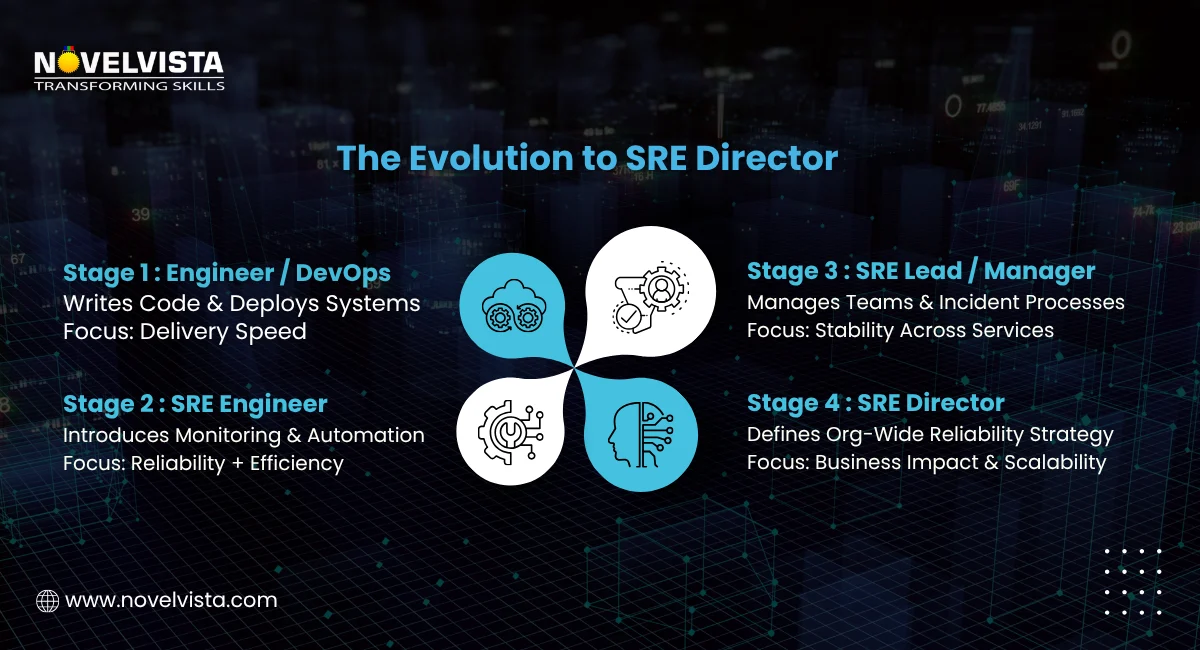
Becoming an SRE director doesn’t happen overnight. It requires a structured career progression.
Most professionals begin as software engineers, DevOps engineers, or SREs.
Transition into roles like SRE team lead or manager.
Work on cross-functional projects and business-critical systems.
With the right experience, you can move into director SRE or SRE director jobs.
The SRE director role comes with significant challenges.
Organizations want rapid releases, but reliability cannot be compromised.
During outages, the SRE director must make quick, high-stakes decisions.
As systems grow, maintaining reliability becomes increasingly complex.
The director of SRE must ensure that engineering priorities align with business objectives.
The future looks promising for the SRE director role.
With advancements in AI and automation, SRE practices are evolving rapidly. Predictive monitoring, automated incident resolution, and AI-driven observability are transforming how reliability is managed.
As organizations continue to scale digitally, the importance of SRE director jobs will only increase. The role is also gaining visibility at the executive level, making it a critical part of business strategy.
The SRE director role has evolved far beyond traditional technical leadership it is now a strategic, business-critical function that directly impacts reliability, customer experience, and revenue. From architecting resilience strategies to leading high-stakes incident response, today’s SRE leaders are expected to combine deep technical expertise with sharp business acumen.
With highly competitive SRE director salary packages and a steady rise in SRE director jobs across industries, this career path is not just in demand it is defining the future of reliability engineering. As organizations double down on uptime, scalability, and digital trust, the need for skilled director of SRE professionals will continue to accelerate.
For those ready to lead from the front, influence enterprise-wide reliability, and drive measurable business outcomes, stepping into an SRE director role isn’t just a career move it’s a strategic leap into the future of modern IT leadership.
Ready to build a strong foundation in Site Reliability Engineering and accelerate your journey toward becoming an SRE leader?
Join NovelVista’s SRE Foundation Training and gain hands-on knowledge of reliability principles, real-world incident management practices, and modern SRE methodologies. Designed for IT professionals and aspiring reliability engineers, this course equips you with the skills needed to manage scalable systems and drive operational excellence.
Start your SRE journey today!

Author Details

Confused About Certification?
Get Free Consultation Call
Stay ahead of the curve by tapping into the latest emerging trends and transforming your subscription into a powerful resource. Maximize every feature, unlock exclusive benefits, and ensure you're always one step ahead in your journey to success.